
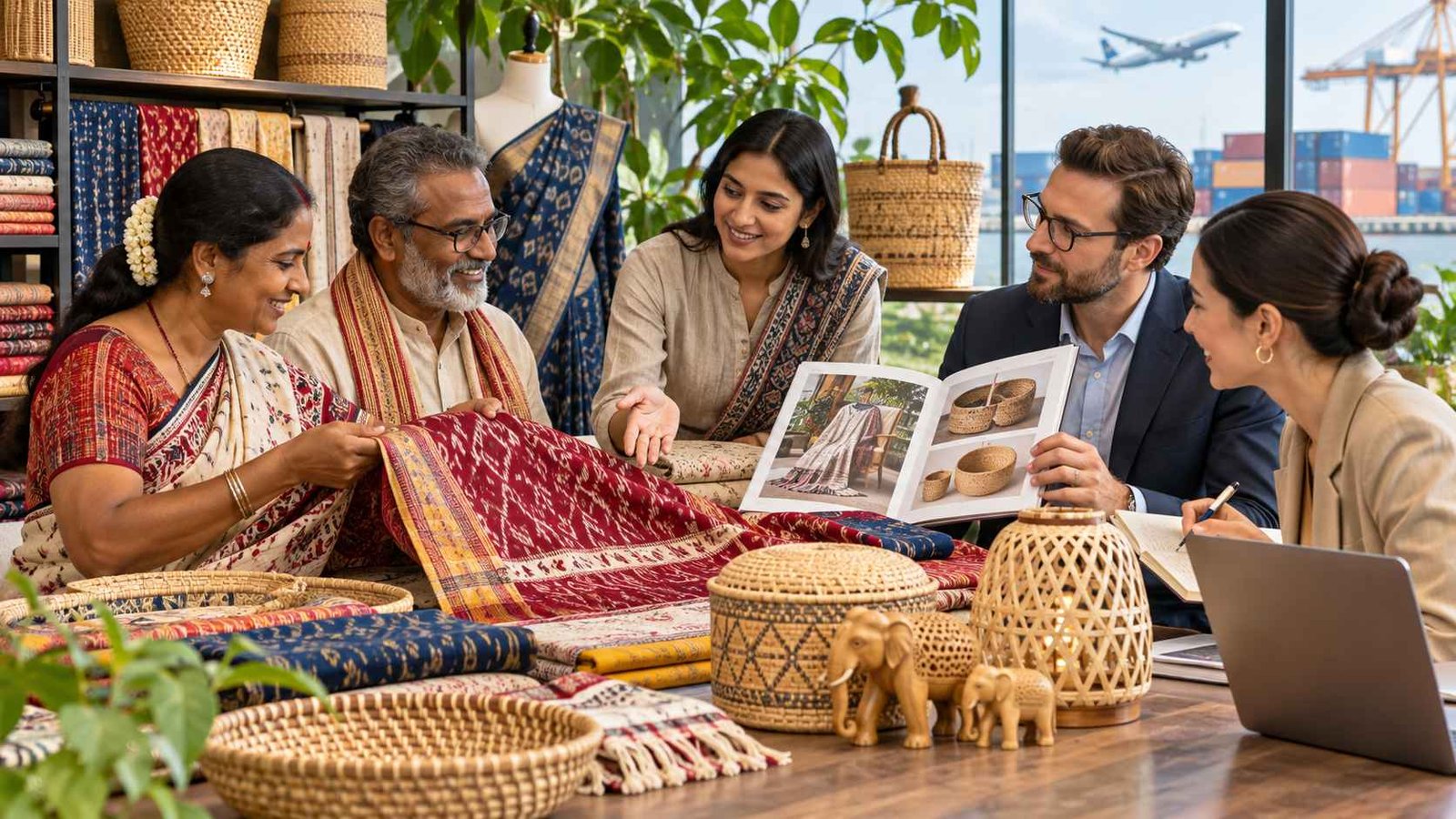
India’s handloom and handicraft sector represents far more than products. It reflects generations of skill, cultural identity, regional knowledge and community-based enterprise. Across the country, artisans and producer groups continue to create products with strong cultural and commercial value. However, the ability to create quality products does not automatically guarantee access to sustainable markets.
For many artisan groups and traditional enterprises, the real challenge begins after production. Questions around product-market fit, contemporary design, branding, presentation, pricing, buyer identification, export readiness and market access often determine whether a product remains limited to a local market or reaches a wider customer base.
This is where structured market-development support becomes important.
Moving Beyond Product Creation
Traditional craftsmanship is often highly specialised, but modern markets require more than craftsmanship alone. Buyers increasingly evaluate products on several factors, including design relevance, quality consistency, packaging, documentation, presentation and the ability of suppliers to fulfil orders reliably.
A strong market-development strategy therefore begins by understanding both sides of the opportunity: the capability of the producer and the expectations of the target market.
This may involve identifying suitable product categories, studying customer preferences, evaluating competing products and understanding which markets are most appropriate for a particular artisan cluster or enterprise.
Instead of changing the identity of traditional products, the objective should be to strengthen their market relevance while preserving the knowledge and craftsmanship that make them distinctive.
Product Development for Contemporary Markets
Product development can play an important role in connecting traditional skills with current customer requirements.
Artisans may already possess strong technical capabilities, but the products created using those capabilities may need to be adapted for different markets. Changes in dimensions, colours, functionality, packaging or product combinations can significantly improve market acceptance.
For example, a traditional weaving technique may be used not only for conventional products but also for contemporary home furnishings, fashion accessories or lifestyle products. Similarly, bamboo, cane, natural fibre and handcrafted products can be developed for different customer segments without losing their traditional character.
The process should be collaborative. Artisans need to remain active participants in product development so that market adaptation strengthens rather than replaces traditional knowledge.
Building a Strong Brand Story
Handloom and handicraft products often have powerful stories behind them.
The origin of the craft, the community involved, the materials used, the production process and the cultural context can all contribute to the value of the product. However, these stories need to be communicated clearly and professionally.
Branding is not only about creating a logo. It includes how the product is positioned, photographed, presented, described and communicated to potential buyers.
A well-structured product catalogue, clear product specifications, professional images and consistent brand communication can make it significantly easier for buyers to understand the offering.
Digital platforms, websites and B2B marketing channels also create opportunities for artisan enterprises to present their capabilities beyond traditional exhibitions and local sales networks.
Understanding Market Readiness
Before entering new markets, enterprises need to evaluate whether they are prepared to meet market requirements.
Export and wider-market readiness may include factors such as production capacity, quality consistency, packaging standards, pricing, order fulfilment, documentation and communication systems.
An organisation may have an attractive product but still face difficulties if it cannot respond to buyer enquiries, maintain consistent quality or deliver orders according to agreed timelines.
A structured readiness assessment helps identify these gaps before market outreach begins.
The purpose is not to delay market entry but to strengthen the enterprise so that new opportunities can be managed sustainably.
Connecting Producers with Buyers
Market access depends on meaningful connections.
Buyer identification should therefore go beyond building a list of companies. The objective is to understand which buyers, distributors, retailers, institutional purchasers or market platforms are genuinely relevant to the product category.
The right connection may differ depending on the nature of the product.
Some enterprises may benefit from direct B2B buyers, while others may be more suited to e-commerce platforms, retail partnerships, exhibitions or institutional procurement.
Building market channels requires research, communication and follow-up. Relationships often develop gradually, especially in international markets where buyers need confidence in product quality, production capacity and supplier reliability.
The Role of Export Development
International markets can create significant opportunities for Indian handloom and handicraft products, but export development requires structured preparation.
Enterprises may need support in understanding documentation processes, packaging requirements, logistics, buyer communication and market-entry considerations.
Export development should therefore be treated as a long-term capability-building process rather than a one-time transaction.
When producers understand both market expectations and export processes, they are better positioned to develop sustainable relationships with international buyers.
Creating an Opportunity-to-Market Ecosystem
The most effective approach is to connect product development, enterprise capability, branding and market access rather than treating each activity separately.
A complete pathway may look like:
Traditional Skill → Product Development → Market Research → Branding → Buyer Identification → Market Linkage → Sustainable Enterprise
Each stage strengthens the next.
This integrated approach can help artisan organisations, producer groups, MSMEs and development agencies move beyond short-term interventions and build stronger enterprise ecosystems.
How Projectibility Supports Market Development
Projectibility works at the intersection of traditional enterprise, skills, education and markets.
Our approach can support organisations with product identification, product development, market research, branding, catalogue development, buyer connections, export-readiness assessment and market-channel development.
The objective is to help traditional capabilities connect with contemporary opportunities while maintaining the cultural and economic value of the products.
India’s artisan economy already has significant capability. The next challenge is to create the structures, partnerships and market pathways that allow this capability to reach wider markets.
Projectibility — Connecting Local Capability with Wider Opportunity.